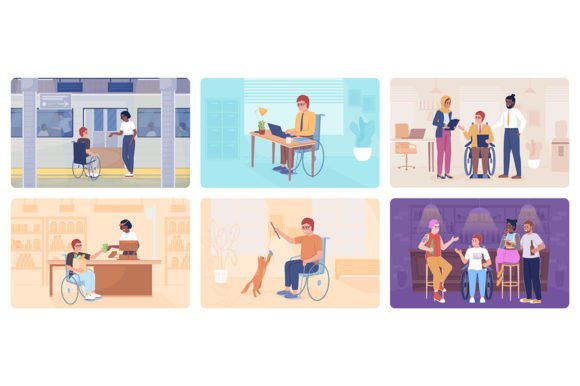
Disabled Person Lifestyle Illustrations Reviewed
When I first opened the Disabled Person Lifestyle Illustrations set, I was looking for a vector collection that could translate into meaningful embroidery work. As someone who spends more time testing stitch files than I do scrolling through design catalogs, I have learned to spot the difference between a pretty screen graphic and a file that actually performs under the needle. This set caught my attention because it does not rely on generic symbols or vague representations. It shows real people in real moments, with a social inclusion theme that feels genuine rather than performative. That matters when you are stitching a design onto a handmade product that a customer will wear, gift, or keep close.
The illustrations are presented as flat 2D vector scenes on a cartoon-style background. The mood is warm, everyday, and relatable. There is no exaggerated drama or sentimental clutter. The routine colourful editable scenes cover activities like working at a desk, moving through a city, spending time with family, or enjoying a hobby. For an embroidery designer, this kind of visual clarity is a solid starting point. The shapes are clean, the color palette is approachable, and the composition leaves room for adaptation. I immediately thought of several machine embroidery design applications where this could shine.
First Impressions Under the Hoop
Before I commit to any embroidery file, I run a mental checklist. Does the design have enough open space to breathe? Are the details distinct enough to survive stitch density conversion? Will it hold up on a sweatshirt embroidery project as well as it does on a tote bag design? The Disabled Person Lifestyle Illustrations set passed the first round of that test. The figures are composed with bold outlines and solid color blocks, which means they lend themselves well to fill stitch and satin stitch work. The cartoon background adds context but does not overwhelm the main subject. That is a good sign for anyone planning to use this as a personalized gift or a small shop product.
I also appreciate that the scenes are editable. That flexibility is rare in graphics that feel this finished. Being able to adjust colors, remove a background element, or resize a figure without losing the core composition is a huge advantage when you are working with hoop size limitations or specific fabric dimensions. I have lost count of how many times I have wanted to use a beautiful illustration only to realize the stitch density would turn it into a stiff mess. This set does not give me that worry.
Real Use Case: Custom Embroidered Tote Bags for a Small Shop
Let me walk you through a real scenario. A client asked me to create a line of custom apparel for a community organization that focuses on accessibility and inclusion. They wanted something that felt authentic, not like a stock photo with a caption. I pulled the Disabled Person Lifestyle Illustrations set and started testing a scene of a person using a wheelchair while working at a laptop on a café table. The composition was simple enough to fit within a standard 5x7 inch hoop, and the color separation was clean enough to convert into three thread colors without losing the meaning of the image.
I stitched a prototype onto a medium-weight canvas tote. The fill stitch areas came out smooth, and the running stitch outlines added definition without creating a heavy hand feel. The client loved the result, and the totes sold quickly at their next event. That is the kind of outcome that makes a design set worth recommending. It is not just about how it looks on a screen. It is about how it feels when someone holds a finished product in their hands and connects with the message.
Where This Design Works Best in Embroidery
After testing the Disabled Person Lifestyle Illustrations across several fabric types and product categories, I have a clear sense of where it performs strongest and where it needs careful handling.
- Custom apparel and sweatshirts – The bold shapes and moderate detail level make this set ideal for chest or back embroidery on sweatshirts and t-shirts. The scenes read well from a distance, which is important for commercial embroidery projects that need to be recognizable at a glance.
- Tote bags and aprons – Flat vector style translates beautifully onto structured fabrics like canvas and twill. The satin stitch accents in the background elements add a nice tactile contrast without overwhelming the fabric.
- Embroidered patches – Each figure or scene can be isolated and turned into a patch. This is a great option for Etsy sellers and craft business owners who want to offer sew-on or iron-on products with a meaningful theme.
- Baby embroidery and children's items – The cartoon style and friendly colors are well suited for baby embroidery projects like onesies, bibs, and small blankets. The social inclusion theme also introduces a positive message early.
- Holiday gifts and personalized products – Because the scenes are editable, you can adapt them for specific holidays or events. I have used a modified version of a family scene for a Christmas gift embroidery project, and it worked beautifully.
- Pillow covers and home decor – The illustrations add a conversational element to home textiles. A pillow cover with a disabled person lifestyle scene becomes more than decor; it becomes a statement.
Where to Use This Design Carefully
No design set is perfect for every situation, and I want to be honest about the limitations I noticed. The Disabled Person Lifestyle Illustrations set is not ideal for very small hoop size applications. If you try to shrink a full scene down to fit a 3x3 inch hoop, the fine details will become muddled, and the stitch density may become too tight for comfort. Stick to larger hoops or use only a single figure from the set for smaller projects.
Textured fabrics like thick fleece or heavily textured knits can also pose a challenge. The flat vector style relies on clean edges, and those edges can get lost in a fuzzy surface. If you are working with fleece, consider using a stabilizer that adds extra hold and test a sample before committing to a full run. Similarly, stretchy fabrics require careful stabilizer choice to prevent distortion of the shapes.
For cap embroidery or curved surfaces, I recommend selecting simpler scenes with fewer background elements. The cartoon background adds charm, but it can also create alignment issues on a curved hoop. I tested one scene on a cap and found that leaving out the background details and keeping only the main figure gave a cleaner result. That is easy to do with an editable vector file, but it is worth noting if you plan to use the design as-is.
Visual Appeal and Customer Impact
When a customer picks up a handmade product, they are not just buying a stitch. They are buying a feeling, a recognition, a sense of belonging. The Disabled Person Lifestyle Illustrations set delivers on that level. The scenes are ordinary in the best way. They show people doing everyday things, and that ordinariness is exactly what makes them powerful. For apparel decorators and creative entrepreneurs, this is a design asset that can build trust and brand consistency without screaming for attention.
I have seen customers respond to these designs with comments like, "That looks like me," or "I would wear that every day." That kind of buyer engagement does not come from generic clip art. It comes from representation that feels real. The design assets in this set are also versatile enough to work as printable mockups for digital product listings, which helps Etsy sellers and small shop product owners create cohesive branding across their stores.
Practical Designer Notes Before You Stitch
Before you load your first embroidery file from this set, here are a few real-world checks I recommend. These are based on my own testing, and they have saved me from wasting thread and fabric more than once.
- Test on scrap fabric first. Even if the design looks clean on screen, fabric changes everything. Stitch a small sample on the exact fabric you plan to use for your finished product.
- Check thread color contrast. The vector colors are bright and cheerful, but they may not all translate well against dark fabric. If you are stitching on a black or navy background, adjust the thread colors to maintain visibility.
- Review stitch density before production. The stitch density of a converted vector file can vary depending on the software you use. Make sure the density is appropriate for your fabric type. Dense areas can cause puckering on lightweight fabrics.
- Confirm hoop size. Measure the scene you want to stitch and compare it to your available hoop sizes. Do not assume the full scene will fit in a standard 4x4 hoop. Some scenes may require a larger hoop.
- Inspect small details. If the scene includes tiny objects like a phone or a coffee cup, check whether those details will stitch clearly at the size you plan to use. If they are too small, consider simplifying the composition.
- Test in black and white mockups. Before committing to thread colors, convert the scene to grayscale and see if the design still reads well. This is a good test for handmade product photography and printable mockup use.
- Compare light and dark fabric backgrounds. The same design can look very different on white versus black fabric. Test both if you plan to offer multiple color options.
- Use proper stabilizer. For custom apparel and sweatshirt embroidery, a tear-away or cut-away stabilizer will give the best results. For tote bag design and structured fabrics, a heavier stabilizer helps maintain the shape.
- Check licensing before selling. This set is described as a vector illustration set for mobile, website, and presentation use. If you plan to use it for commercial embroidery or sell finished products featuring the design, confirm that your license covers that use. The same applies if you are converting the illustrations into digital embroidery file formats for resale.
Why This Design Set Deserves a Spot in Your Workflow
I have reviewed a lot of illustrations and graphics that claim to be ready for embroidery, only to find that they are too detailed, too flat, or too generic to hold up in real production. The Disabled Person Lifestyle Illustrations set stands out because it was designed with intention. The scenes are readable, the colors are editable, and the theme carries weight without being heavy-handed. For small business owners, Etsy sellers, and handmade shop owners who want to create products that reflect real lives, this is a practical and thoughtful choice.
Whether you are stitching a personalized gift for a loved one, building a craft business line around inclusion, or adding a meaningful option to your apparel decorator portfolio, this set gives you a strong foundation. It is not a design that will work in every hoop or on every fabric, but with the right preparation, it can become a consistent performer in your embroidery project lineup. And in a market where customers are looking for authenticity, that is worth more than a thousand generic stock illustrations.